Smarter EOAT Design: Enabling Advanced Positioning, Clearer Vision, and Full Media Integration
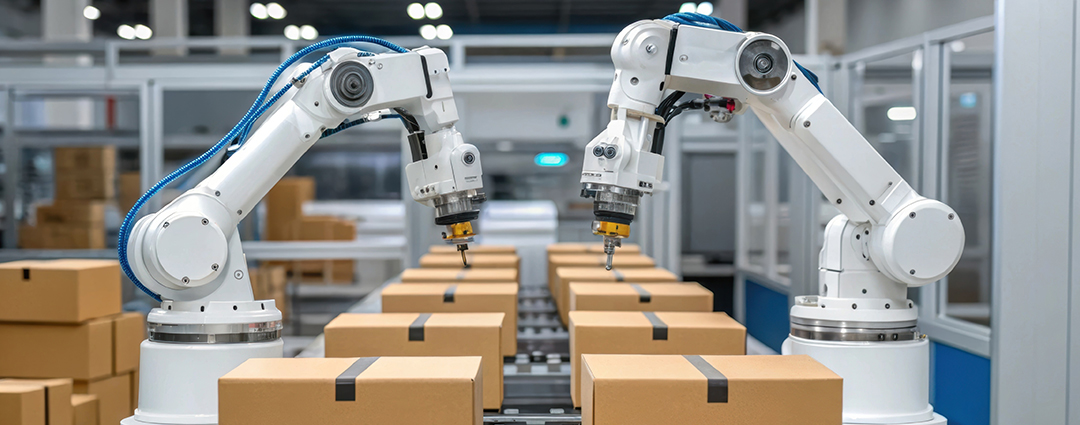
As packing optimization becomes a top priority across manufacturing and distribution industries, robotic End-of-Arm Tooling (EOAT) is being pushed to do more than ever before.
Modern systems must handle greater SKU variety and faster cycle times while maintaining absolute reliability. To achieve this, engineering teams are prioritizing two critical EOAT design shifts:
- Eliminating bulky hose bundles that obstruct 3D vision systems and barcode scanners to prevent "phantom" line stoppages.
- Enabling precision positioning to drive faster cycle times, reduce rework, and ensure consistent pack quality.
Limitations of External Hose Bundles
Traditional EOAT designs rely on external hose bundles and exposed cabling to route vacuum, pneumatic lines, power, and data. While functional, these bundles create significant performance challenges:
- Obstructed or inconsistent camera views
- Reduced positioning accuracy due to drag and torsional resistance
- Limited rotational freedom
- Cable fatigue and premature wear
- Increased maintenance and downtime
As vision-guided robotics become more sophisticated, and as more EOAT designs integrate sensors, cameras, and smart tooling, these constraints become more pronounced.
The Shift Toward Fully Integrated Rotary Union Assemblies
In high-speed pick-and-place or palletizing, an external hose bundle is not just a maintenance cost. It is an optical obstruction and an unpredictable risk. Beyond the wear and tear of constant flexing, if a hose sags into the field of view of a 3D vision system or a barcode scanner, the line stops.
To minimize the risk of failure while meeting the speed requirements of packaging lines, engineering teams are moving away from external hose management in favor of integrating rotary unions directly into EOAT assemblies.
By routing vacuum and pneumatic pressure internally, these systems eliminate the need for external bundles, ensuring that cameras and sensors maintain a clear line of sight to the product. Whether an application requires pneumatic air transfer, vacuum, or high-pressure hydraulics, integrated single- or multi-passage rotary unions provide the clean, reliable flow necessary to support the industry’s most demanding cycle rates.
In addition, by integrating electrical slip ring technology directly into the fluid rotary union, manufacturers can consolidate power and data, including Ethernet and fiber optics, into a single compact assembly.
Working with experienced rotary union manufacturers and trusted rotary union suppliers, automation teams can select standard rotary unions or develop custom rotary unions for specialized applications.
System Precision and Vision Integrity
With the umbilical removed, vision systems gain unobstructed sightlines for improved alignment in high-mix packaging environments. Furthermore, the absence of hose drag allows for precise SKU orientation and improved placement accuracy, as robots can move more naturally and efficiently, without having to compensate for resistance or entanglement risks.
Improved Reliability and Reduced Maintenance
By eliminating external hose twisting and cable fatigue, integrated assemblies significantly reduce wear points and unplanned downtime. Consolidating fluid and electrical transfer into a single engineered unit also simplifies installation and long-term serviceability.
For high-cycle packaging applications, this translates directly into improved uptime and lower total cost of ownership.
Designing for the Next Generation of Packaging
As packaging operations continue to prioritize speed, flexibility, and precision, EOAT design must evolve accordingly.
Integrated rotary union assemblies, combined with electrical slip ring technology, are no longer just space-saving upgrades. Integrated rotary union assembly design is a strategic decision that enables:
- Faster cycle times
- More consistent pack quality
- Improved vision system performance
- Continuous high-speed data transfer
- Reduced maintenance and downtime
For automation teams focused on maximizing throughput while maintaining precision, smarter EOAT design is becoming a competitive advantage, and integrated fluid and electrical transfer is at the center of that evolution.