Defense Solutions Radar Cooling Systems
Advanced Thermal Management for AESA and Phased-Array Radars
High-Performance Thermal ManagementModern active electronically scanned array (AESA) and Phased-array radar systems generate extreme heat that requires liquid cooling to maintain signal accuracy and hardware.
DSTI's specialized rotary unions facilitate the continuous 360° transfer of coolants, that have been deployed across sea, land, air, and space-based platforms.
These purpose-built fluid rotary joints are engineered for mission-critical radar applications to reduce space, weight, torque, and pressure drop while preserving maximum equipment service life.
Contact Us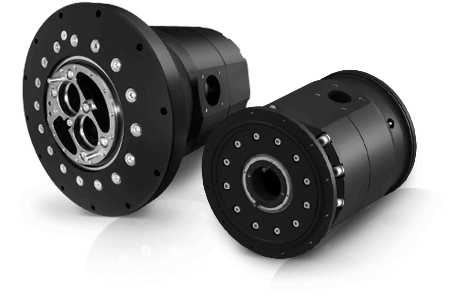
Technical Specifications
High Flow Designs With Minimal Pressure Drop
Customized To Accommodate Limited Space Designs
Long Life Sealing Systems Utilizing Mechanical Face Seals
Wide Range Of Material & Plating Options

Engineering Requirements for Radar Cooling Rotary Unions
As power densities in modern radar systems increase, the demand for active cooling grows. DSTI helps optimize cooling performance through the following technical optimizations:
- High-Flow, Low-Pressure-Drop Design: Internal passages are engineered to maximize flow, minimize turbulence, and minimize pressure drop.
- Low Drag Torque Design: Mechanical face seals are engineered to minimize drag torque at operating speed. In antenna systems, rotary union torque impacts motor sizing, efficiency, and accuracy. DSTI measures and validates drag torque under operating conditions for every unit.
- Reliable Isolation: Multi-passage rotary unions feature redundant sealing to ensure reliable isolation between flow passages, preventing cross-contamination.
- Geometric Integration: Custom working envelopes are developed to accommodate the limited space designs inherent in mobile and airborne radar housings.
Design Verification & Qualification
DSTI builds trust by providing technical validation for every defense project:
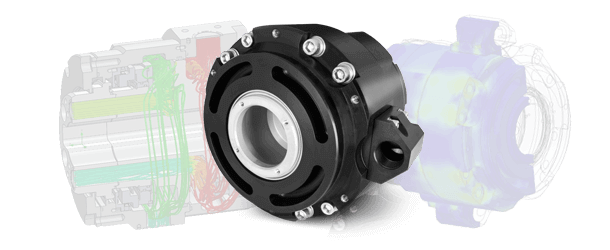
FEA / CFD Analysis: We perform Finite Element Analysis and Computational Fluid Dynamics to verify design capabilities.
Shock & Vibration Analysis: Structural integrity is validated against application-specific shock and vibration profiles using analysis and physical testing.
Lifecycle and Operation Testing: Operation and life qualification testing are tailored to meet specific program requirements, ensuring the rotary union survives its intended service duration.

- Designs to meet flow, pressure, speed, and temperature requirements
- Reduced torque design
- Reliable isolation between flow passages
- Wide range of material and plating options
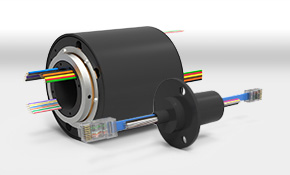
- Custom electrical slip ring integration per requirements
- FEA / CFD analysis to verify design capabilities including environmental conditions, pressure, and temperature drops
- Factory acceptance testing reports sent with each unit
- Operation and life testing tailored to meet project and customer requirements
Overview
DSTI radar cooling rotary unions support liquid-cooled rotating radar architectures used across defense and aerospace platforms.
These designs are developed around the realities of modern phased-array systems: high heat loads, limited installation envelopes, low torque targets, and strict reliability requirements over long duty cycles.
Whether the project requires a modified standard platform or a fully custom assembly, DSTI can help define the right passage configuration, sealing approach, material package, and validation plan for the program.
Need combined fluid and electrical transfer in the same package? DSTI also supports integrated fluid and electrical solutions for applications that require coolant, power, signal, and data transfer through one rotating interface.
Radar Cooling FAQ
How do rotary unions manage the transition between stationary pumping modules and rotating AESA arrays?
The rotary union acts as the central dynamic manifold, bridging the stationary coolant supply to the rotating antenna. DSTI designs ensure that this transition maintains the required flow rate and pressure without introducing air or contaminants that could degrade the dielectric properties of the cooling media.
How do rotary unions maintain low pressure drop at high flow rates?
Through CFD validated coolant flow analysis, DSTI optimizes internal passage transitions and diameters. By eliminating sharp dead-head corners and minimizing turbulence, we reduce parasitic energy loss, allowing the system to maintain thermal stability with lower pump-head requirements.
How are radar cooling rotary unions tested for shock and vibration?
Units are subjected to mission-profile testing per MIL-STD-810. This includes resonant frequency dwells and high-impact shock testing (e.g., ballistic or sea-state shock) to ensure that mechanical seals maintain contact and bearing races do not brinell under extreme G-loads.
Can fluid rotary unions be integrated with electrical slip rings?
Yes. DSTI specializes in custom electrical slip ring integration. This allows for a unified rotating assembly that transfers cooling media alongside high-voltage power, high-frequency signals, and Ethernet through a single, space-optimized centerline.